If you feel that the world has gone mad, spinning out of control, you're not alone. It has. You're right.
Over the last few years alone, we lived through a global pandemic, wars, supply-chain collapse, an energy crisis, economic whiplash, and the rise of AI. Not one at a time. Everything, everywhere, all at once. COVID hit global supply chains, which spiked inflation, which reshuffled geopolitics from Ukraine to Israel to Hormuz and Taiwan.
This is what experts call a polycrisis. Not a sequence of separate problems, but a web where each one deepens the others.
And it's not slowing down. At the time of this writing, scientists warn that another global pandemic is a matter of when, not if. Weather models are forecasting what could be the strongest El Niño in 140 years, driving famine and mass migration. Meanwhile, the conflict around Taiwan threatens to reach a climax around 2027, sending global powers at each other's throats. And energy prices, spiked by the Hormuz conflict, show no sign of coming down. Each crisis feeding the next. Each adding fuel to the fire.
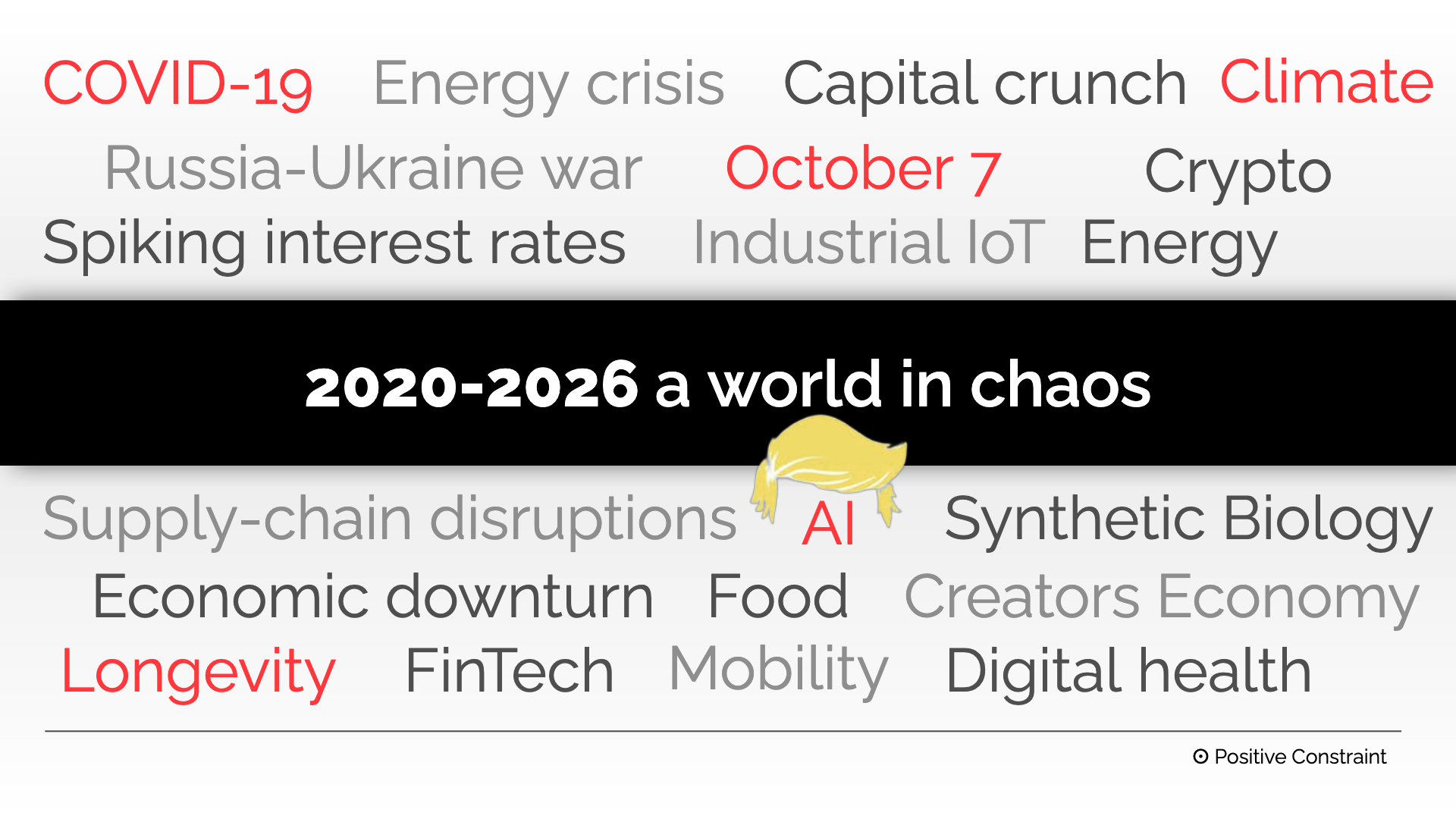
Even without a single crisis, our world would still be changing fast
But even without a single crisis, our world would still be changing fast. Technology alone would see to that.
In 2016, one analysis listed 73 ways driverless cars will change our lives. People will know exactly when they need to leave and when they will arrive. Parents will trust a secure service with their children. Without the burden of car ownership, how we spend and save money will change. Where we live, how our cities look, and how we spend our time will all change. Seventy-three implications, from one technology.
And that's just driverless cars. Every aspect of our lives is going through its own disruption. Longevity is changing how long we live and how well we age. How we grow and consume food is being reinvented. How we generate and store energy. We're venturing into space and plan to settle on Mars. And then there's AI, of course, upending everything it touches.
Each of these will reshape our lives as deeply as driverless cars, sending its own ripples throughout society. Predicting how one might change our lives is possible, in isolation. But these disruptions are not happening in isolation. They are all happening at the same time, in one big turbulent pool. Predicting how all these crises and disruptions will affect us is impossible.
For the first time ever, as historian Yuval Noah Harari says, we have no idea what our world will look like in 20 years. A thousand years ago, we taught our kids how to shoot a bow or how to pick mushrooms in the forest. A hundred years ago, we encouraged them to become doctors, lawyers, or engineers to make the most of the new world. The very basic aspects of life were predictable. Not anymore.
If the rate of change on the outside exceeds the rate of change on the inside, the end is near.
— Jack Welch
If we can't predict the future, perhaps we can ride its wave instead. Adapting to change is what we've always done. It makes sense. As Jack Welch, one of the sharpest business minds of the 20th century, put it, outchange your environment, or die. And for a long time, it worked.
It doesn't work anymore.
Adapting assumes you can outchange your environment. But how do you outchange a world that moves faster than you do? By the time you adapt to your new reality, the world will change twice over.
It doesn't mean you shouldn't try. But constantly changing, riding wave after wave, is exhausting and unsustainable. People and organizations can only take so much before being overwhelmed by even faster and bigger changes.
For the first time in human history, the world is too complex to predict and too fast to adapt to. The possibilities of what might happen tomorrow, next month, next year have exploded. What used to work no longer does.
We need a different strategy. We need to Embrace the Unchanging.