Imagen has a real product edge that none of its competitors can match. But its messaging buries that edge behind language customers can't understand. Without changing the product, just the story, Imagen could stand out and win. This review shows how constraints thinking turns a positioning problem into a new category.
The Villain
Wedding, sports, and music festival photographers are examples of high-volume batch photographers. In each job, they shoot 1000 to 10k of raw images. In a given year, it can get to more than 100K images.
The job doesn't end after they click the shutter button. After the event is over, they have to go over thousands of images, select the right ones (in a process called culling), and edit them to their taste — apply color corrections, filters, touch-ups, etc. This process can easily take 14–15 hours per project. If you've ever waited weeks or months for your wedding album, this is one reason why. It's a tedious, monotonous process that leads to burnout and long wait times for customers.
The Hero
A long wait for a wedding album led Imagen's founder to come up with a solution. "The photographer was just knee-deep in processing, culling, and editing our photos." So why not use AI for that?
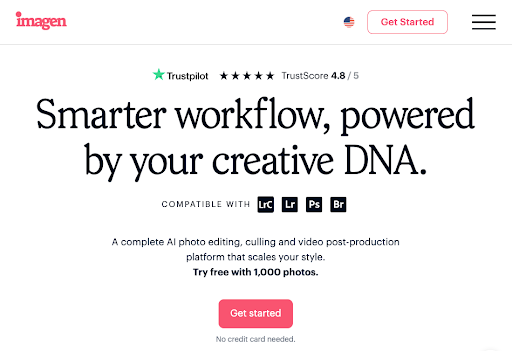
AI is great at scaling and automating this grunt work. Instead of manually sorting through thousands of images and adjusting filters one by one, Imagen uses AI to automate the entire process. With it, photographers can finish a 15-hour job in less than 15 minutes. Imagen describes it as "A complete AI photo editing, culling and video post-production platform that scales your style."
Standing Out
Imagen isn't alone in this market. Several players sell similar promises.
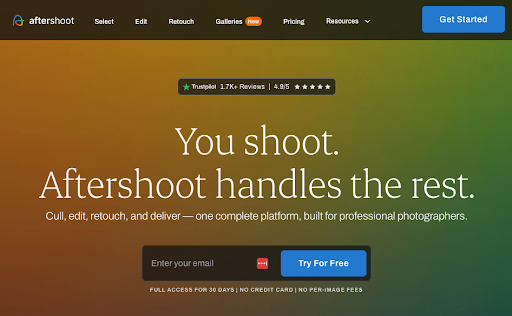
Aftershoot does AI culling and editing with offline processing. Their promise is "You shoot, we handle the rest", saving time and taking away the grunt work from the photographer.
Evoto leads with portrait retouching. They also offer to take care of the entire end-to-end workflow, including culling and retouching.

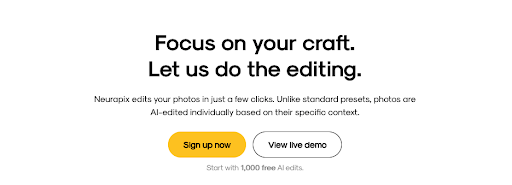
Neurapix lives inside Lightroom, already embedded in the photographer's main workflow tool, and calls to "Focus on your craft. Let us do the editing".
If you're a photographer with thousands of images to process every time, which would you pick?
People today have the attention span of a fruit fly. They don't read the fine print or go into detail. For someone browsing for a solution, all of these alternatives promise to automate the workflow. All of them save time and take the grunt work away. All of them look and feel the same.
That's the challenge Imagen has to deal with.
Imagen's Constraint
Photographers don't just sell photos. Everyone with a high-end camera can take photos. People pay $5000 for a wedding photographer because of their style. Their shooting and editing style is their primary product, the reason they can charge a premium, and their competitive edge over others. You choose one photographer over the other because you like how their work makes you feel. Imagen realized that early and baked it into their product:
It's really important for a photographer to maintain their personal editing style. They wouldn't want an automatic tool that edits everything without their personal touch. It was important for us to keep the editing personal, so it wouldn't be one way to edit for everyone.
In the Positive Constraint framework, constraints are the language of the unchanging. The most powerful constraint in Imagen's story is their customers' taste. It's the one thing that is stable over time, unchanging in that brand's narrative, shaping everything around it.
Imagen's product already serves that. As part of the onboarding process, customers are asked to upload a minimum of 3000 previously edited photos so Imagen can learn their taste. From that point on, Imagen delivers images as if the photographer processed them manually.
But that promise is buried behind copy that is hard to unpack and easy to overlook.
Cognitive Gap
What does a photographer picture when they read "Creative DNA"? What's the impression this copy leaves? How does it move the customer? I'd say not much.
Next to "your craft", "handle the rest", and "end-to-end", "creative DNA" blends right in. It's trying to signal something none of the others have, but customers skim right past it. It doesn't land instantly, so it doesn't land at all.
That distance between what a brand wants the market to understand and how the market actually understands it is called a cognitive gap. When customers face a cognitive gap, they close it themselves. Maybe they'll get it, maybe they won't. Maybe they'll arrive at the wrong conclusion entirely and move on. It's out of your control.
High-volume batch photographers, Imagen's ideal customers, don't have the time to work out what "creative DNA" means. They'll pick whichever tool they click with first.
The Apprentice
How can Imagen communicate its edge instantly in a way that makes photographers pay attention? By positioning itself not as a 'workflow' tool or a 'complete platform,' but as an AI apprentice for batch photographers.
Imagen could position itself as the AI Apprentice for batch photographers.
Imagen sells photographers' taste back to them because that's what an apprentice does. Takes the grunt work from the expert. Learns the taste. And unlike a human apprentice, an AI one learns fast, works even faster, and never quits to open its own gig.
Positioning itself as an AI apprentice would also help customers adopt Imagen's product by packaging it in a familiar form. They may not upload 3000 photos to train a tool, but they would to train their apprentice.
Owned Position
This positioning solves two things. First, it changes the customer's relationship to the product. Imagen will no longer compete against platforms or workflow tools. They'll be offering an emotional value next to a logical one. It's an apprentice that takes work off your back. It's AI, so it does it quickly. And it's yours, learning YOUR taste and preferences, delivering work as if you did it yourself.
Everything Imagen excels at, packaged in an easy-to-grasp, visceral term that helps photographers tell the difference instantly.
Second, by framing itself as the AI Apprentice for batch photographers, Imagen can create a category-defining market position that competitors cannot easily steal. Any competitor who tries to adopt the apprentice framing will look like an imitation. When you define the category, everyone else plays by your rules.
Imagen's product is built around the right constraint. The customer's taste is the unchanging element that shapes everything they do. Closing the cognitive gap and letting customers see that turns a crowded market into a category of one.